


TATZU
NEO SAMURAI Aloha Shirt XL | Yellow Ground with Colorful Flowers
NEO SAMURAI Aloha Shirt XL | Yellow Ground with Colorful Flowers
Couldn't load pickup availability
NEO SAMURAI
Remade Kimono × Avant-Garde × Mode × Street = Reborn Identity
TATZU is a fashion brand that deconstructs vintage Japanese kimono and reconstructs them into avant-garde silhouettes and contemporary mode-inspired streetwear.
Japanese designer and pattern maker TATZU draws on Japanese aesthetics and spirit to create a new identity through contemporary fashion.
NEO SAMURAI embodies TATZU's distinctive style and philosophy.
This original aloha shirt embodies NEO SAMURAI, TATZU's distinctive fashion style.
Drawing on the unique colors and patterns of vintage kimono, this garment brings together contemporary silhouettes, comfort, functionality, and refined construction.
Product Type: Ready-to-Wear
Size: XL
Style: Unisex (Men's button configuration — buttons on the right)
Availability: One of a Kind (Only one available)
1. About This Item
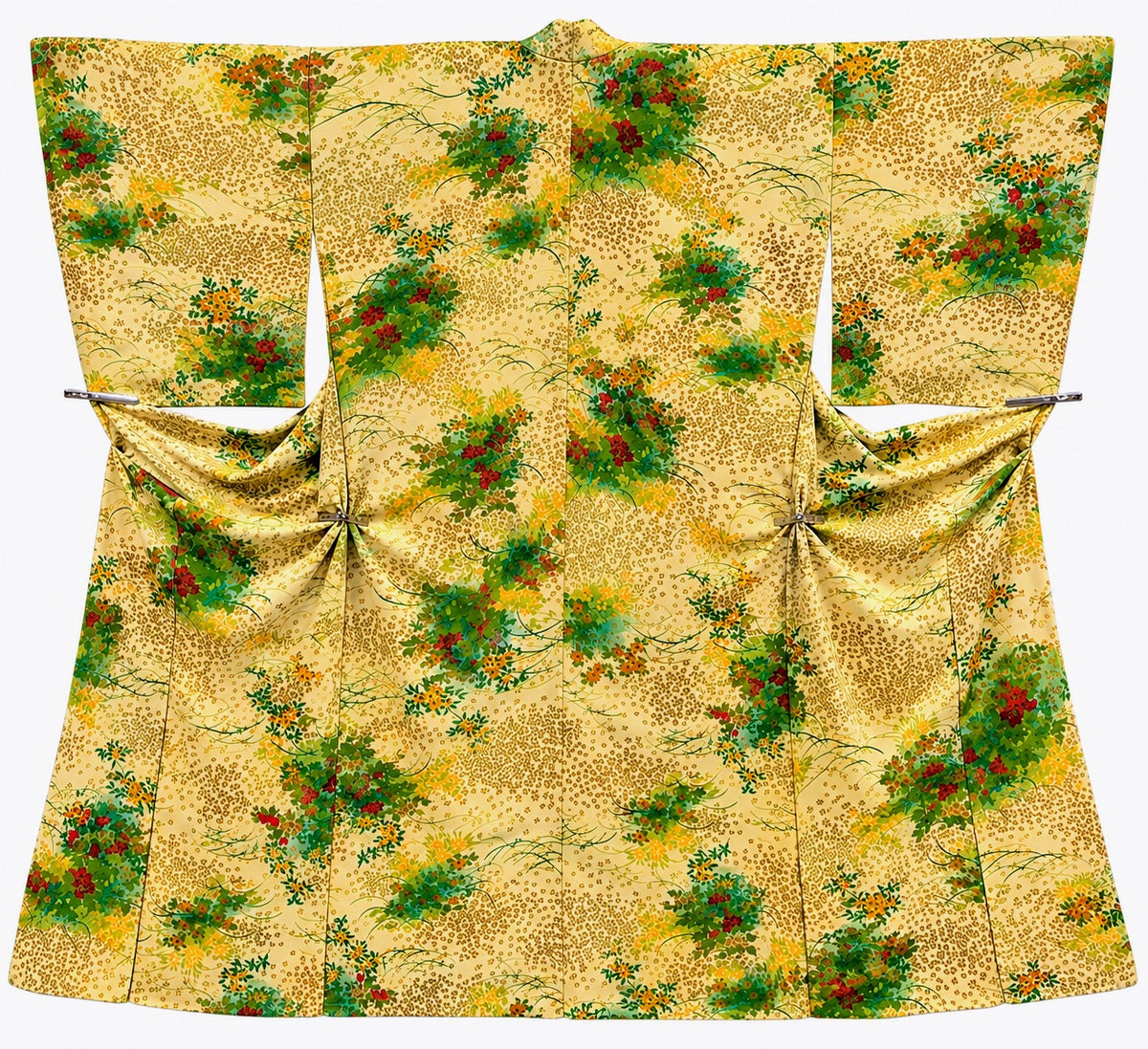
Crafted from vintage Japanese kimono fabric featuring green, red, orange, and yellow botanical motifs against a soft yellow background.
Vibrant botanical colors are layered over a delicate floral background, creating a design that balances expressive beauty with subtle refinement.
Carefully considering the overall colors and flow of the original kimono patterns, the motifs are redistributed across the front, back, sleeves, collar, and pocket.
From black-based, mode-inspired outfits to streetwear styled with denim or wide-leg trousers, this piece offers a wide range of styling possibilities.

2. TATZU Original Design
TATZU's aloha shirts are original garments developed through distinctive pattern making by a Japanese designer, with careful consideration of the characteristics of vintage kimono fabric.
Unlike conventional fabrics used in contemporary clothing, kimono fabric is limited in width. To achieve a contemporary silhouette and generous body width within these constraints, TATZU develops its own panel configurations and construction methods.
Rather than retaining the original shape of the kimono, we deconstruct it into fabric panels and design and reconstruct it into an entirely new garment.
Going beyond the inherent beauty of the material and pursuing refinement as a fashion garment is fundamental to TATZU's approach to garment making.

3. Fit & Silhouette
Featuring an open camp collar and a relaxed, boxy silhouette with generous body width.
The oversized design carefully balances the shoulders, body, and sleeves, creating a comfortable fit without closely following the contours of the body.
Wear it buttoned up or open over a T-shirt or tank top for different styling possibilities.
Designed without limitations of gender or age, this unisex garment can be styled according to individual body shapes and personal fashion preferences.

4. Construction & Details
TATZU's aloha shirts are designed with careful attention to every detail, considering not only visual appeal but also comfort, freedom of movement, and durability.
The following sections introduce the fundamental construction and sewing details of TATZU's original aloha shirts using a representative model.
01. Additional Fabric Panels
Traditional kimono fabric is generally around 35–40 cm wide, considerably narrower than conventional fabrics used in contemporary clothing.
Achieving a generous body width therefore requires a different approach to pattern making from that of conventional shirts.
TATZU incorporates additional fabric panels into the body of the garment, accommodating the limited width of kimono fabric while creating an oversized silhouette.
Careful attention is also given to the balance of colors and patterns across the panel seams, incorporating the limitations of fabric width into the design itself.

02. Precision Collar Construction
An open camp collar creates a naturally relaxed neckline.
The collar shape, opening, and connection to the shirt body are carefully designed. Concealed stitching techniques contribute to a clean, refined finish.
As the collar plays an important role in framing the face, particular attention is given to its shape and the precision of its construction.

03. Careful Pattern Matching
A five-sided patch pocket with a pointed base is positioned on the left chest.
Suitable sections are carefully selected from the limited available kimono fabric, then cut and sewn so that the patterns of the pocket and shirt body align as naturally as possible.
This approach maintains the functionality of the pocket while preserving the overall visual flow of the fabric patterns.

04. Double-Layer Back Yoke
A double-layer back yoke extends across the shoulders and upper back, using patterned kimono fabric for both the outer and inner layers.
This construction is designed with consideration for strength and durability in the shoulder area, where the garment experiences stress during wear.
By using kimono fabric even on the less visible inner layer, the design combines structural integrity with a refined finish.

05. Back Pleats
Two back pleats are positioned below the back yoke, one on each side.
These pleats provide additional room across the back when reaching forward or moving the shoulders.
A functional detail designed to accommodate everyday movement while maintaining a relaxed silhouette.

06. Side Slits
Side slits are incorporated into both sides of the straight hem.
They allow greater freedom of movement around the hips and help reduce tension on the hem when sitting or walking.
When worn untucked, the shirt maintains a natural drape and a clean silhouette.

07. Premium Seam Construction
TATZU does not use overlock machines. Instead, construction techniques such as flat-felled seams and French seams are selected according to the garment components and seam locations.
By enclosing the raw edges of the fabric within the seams, these techniques help prevent fraying while enhancing seam strength and durability.
Attention is given not only to the exterior appearance but also to the interior construction, pursuing refined sewing quality and a clean finish throughout the garment.

08. Original TATZU Coconut Buttons
The front features original TATZU buttons made from natural coconut shell.
The distinctive colors and textures of this natural material complement the character of vintage kimono fabric.
Buttons and other garment components are considered integral elements of the overall design, with particular attention given to their harmony with the fabric.

09. TATZU Signature Logo
TATZU uses two original brand labels, each serving a distinct purpose.
The left sleeve features a brand label with a gold symbol and white TATZU lettering.
Inside the back neckline, a second brand label features a red symbol, gold TATZU lettering, and the words “Japonaise Reborn.”
These signature brand details bring elements of contemporary streetwear into the distinctive colors and patterns of vintage Japanese kimono.

5. Product Specifications
-
Open camp collar
-
Short sleeves
-
Oversized, boxy silhouette
-
Six-button front closure (Men's button configuration — buttons on the right)
-
Original TATZU coconut buttons
-
Five-sided patch pocket on the left chest
-
Pattern matching between the shirt body and pocket
-
Additional fabric panels for generous body width
-
Double-layer back yoke
-
Two back pleats, one on each side
-
Straight hem
-
Side slits on both sides
-
Enclosed seam finishes using techniques such as flat-felled seams and French seams (No overlock stitching)
-
TATZU brand label on the left sleeve
-
TATZU brand label inside the back neckline
-
Unlined construction
-
Unisex design
6. Size Guide
TATZU's original aloha shirts are designed in five sizes: M, L, XL, XXL, and XXXL.
The relaxed, oversized silhouette is designed for wear regardless of gender.
This item is size XL.
| Size | Length | Body Width | Shoulder Width | Sleeve Length | Upper Arm Circumference |
|---|---|---|---|---|---|
| M | 72 | 60 | 48 | 27 | 46 |
| L | 73 | 64 | 50 | 29 | 49 |
| XL | 75 | 68 | 53 | 30 | 52 |
| XXL | 76.5 | 71 | 55 | 31 | 54 |
| XXXL | 78 | 74 | 57 | 32 | 56 |
Unit: cm
*The measurements above represent the standard finished garment dimensions of TATZU's original aloha shirts.
*Due to the characteristics of vintage kimono fabric and the individual construction of each garment, finished measurements may vary slightly.
*This item is a completed, one-of-a-kind garment. The size chart does not indicate availability in all sizes. Only the single garment in the size specified on this product page is available for purchase.
We recommend comparing these measurements with a shirt you already own to determine your preferred fit.
7. Materials
Main Fabric: Vintage Japanese kimono
Buttons: Natural coconut shell
Lining: None
TATZU primarily works with vintage kimono collected and selected in Japan.
Each kimono differs in fabric thickness, texture, luster, drape, and the characteristics of its weaving and dyeing, giving every garment its own distinctive character.
As many vintage kimono no longer have original fiber content labels, the exact fiber composition and blend percentages may not always be identifiable.

8. From Vintage Kimono to Aloha Shirt
TATZU's garments are not created simply by cutting and altering the shape of an existing kimono.
From material selection and deconstruction to fabric preparation, pattern making, pattern placement and matching, cutting, sewing, and finishing, each garment undergoes a complete process of reconstruction.
The following sections introduce the production process of TATZU's original aloha shirts using a representative model.
STEP 01. Vintage Kimono Selection
From vintage kimono collected in Japan, we select materials suited to the intended design by carefully examining their colors, patterns, textures, and fabric condition.
We explore the potential of each material while considering the finished silhouette and how its patterns will appear on the completed garment.

STEP 02. Kimono Deconstruction
The original stitching of the kimono is carefully unpicked, separating the body, sleeves, collar, and other components back into individual fabric panels.
To make the most of the limited available fabric, this process is carried out carefully to avoid damaging the material.

STEP 03. Fabric Washing
Depending on the condition and characteristics of the material, the deconstructed fabric is washed or pre-soaked in water before cutting.
This process helps minimize the risk of shrinkage and dimensional changes after the garment is completed.
Our consideration extends beyond the moment a garment is finished to how our customers will wear and continue to enjoy it over time.
Although this preparation requires additional time and effort, preparing the fabric with its future use in mind is an essential part of how TATZU defines quality.

STEP 04. Fabric Preparation & Inspection
After washing and drying, the fabric is pressed to remove, as much as possible, the original fold lines and seam marks left from its previous construction as a kimono.
At the same time, the entire fabric is carefully inspected to identify suitable sections for use, taking quality and the intended finish into consideration.
This is an important stage in preparing the material for cutting and sewing.

STEP 05. Pattern Making
Using TATZU's original garment patterns as a foundation, the pattern pieces are adjusted according to the width, available length, and characteristics of the kimono fabric.
The body width, shoulder width, sleeves, collar, and configuration of each component are carefully considered to achieve the intended silhouette using the limited available fabric.

STEP 06. Pattern Placement & Matching
At TATZU, design, garment pattern making, and fabric pattern placement and matching are inseparable.
The garment pattern pieces are positioned directly on the fabric, with the placement of each component determined by considering how the motifs will appear on the finished garment.
The balance of colors and patterns across the front, back, sleeves, collar, pocket, and additional panels is carefully examined.
As the available motifs and fabric quantities are limited, the placement is designed within the constraints of each material to achieve natural continuity between components wherever possible.
Rather than simply positioning patterns, we design their placement as an integral part of the entire garment.
Even when using the same kimono, different pattern placements can dramatically change the appearance of the finished garment.

STEP 07. Fabric Cutting
Once the garment patterns, fabric pattern placement, and pattern matching have been finalized, each component is carefully cut.
Every vintage kimono is unique.
Once the fabric has been cut, the process cannot be reversed.
For this reason, the position of each motif and the overall visual balance are checked one final time before the fabric is precisely cut according to the garment pattern pieces.

STEP 08. Sewing & Construction
At this stage, the individual flat fabric pieces begin to take shape as a three-dimensional garment.
Vintage kimono fabrics vary in thickness, softness, firmness, and texture.
Rather than applying the same sewing method to every material, construction techniques must be selected according to the characteristics of the fabric and the structure of the garment.
Using industrial sewing machines, each component is precisely assembled to preserve the silhouette established during pattern making. Particular attention is given to details such as the collar, pocket, back yoke, pleats, and side slits.
Inside the garment, techniques such as flat-felled seams and French seams are selected according to the seam location, with consideration for fraying prevention and durability.
Hand sewing is also incorporated where necessary, including detailed sewing work and button attachment.
A beautiful silhouette. Strength in construction.
In every detail, both visible and unseen.
Together, these details define the refinement of the finished garment.

STEP 09. Finishing & Quality Control
After sewing, loose threads are trimmed, the garment is pressed, and the buttons and individual components are checked.
Finished measurements, sewing quality, pattern placement, and the overall silhouette are carefully examined before the garment passes its final inspection.
Through these stages and the hands of those who create it, vintage kimono is reborn as an entirely new garment.

BEHIND THE CREATION
Discover TATZU's creative process through film.
Explore the transformation of vintage kimono into new garments through a promotional film that captures both the production process and TATZU's creative vision.
9. Design & Production System
Designed by TATZU. Crafted in Phnom Penh, Cambodia.

Based in Phnom Penh, Cambodia, TATZU brings together Japanese designer and pattern maker TATZU and a local production team to create its garments.
Supporting this creative process is a partner production workshop with which TATZU has built a collaborative relationship spanning approximately ten years.
This relationship goes far beyond simply handing over completed designs for production.
TATZU is directly involved in the production process, sharing approaches to pattern making, sewing techniques, and material handling with the production team. Together, they have developed their skills through years of creating garments.

Pattern makers who understand TATZU's design intentions and collaboratively develop garment patterns.
Sewing specialists who understand the characteristics of the materials and bring each garment to life.
And a shared creative understanding built through years of working together.
As every vintage kimono is different, this close collaboration allows the team to make the necessary decisions and adjustments at each stage, from design to completion.
A production system in which designers and makers work directly together, pursuing the refinement of every garment.
This is the foundation of TATZU's garment making.

10. Care Instructions
To preserve the distinctive textures and colors of vintage kimono fabric over time, we recommend the following care instructions.
-
Dry cleaning is recommended.
-
If washing at home, gently hand wash separately in cold water, keeping in mind the possibility of color bleeding and shrinkage.
-
Avoid prolonged soaking and excessive rubbing.
-
Do not use bleach, washing machines, or tumble dryers.
-
After washing, gently reshape the garment and air dry in the shade, away from direct sunlight.
-
If wrinkles are a concern, ironing while the fabric is still slightly damp, before it dries completely, can help smooth them out.
-
Once the fabric is completely dry, lightly mist it with water before ironing if necessary, taking care to consider the condition of the fabric.
-
When ironing, use a pressing cloth and start at a low temperature, adjusting the heat according to the condition of the fabric.
-
Store away from high temperatures, humidity, and direct sunlight.
11. One of a Kind
No two garments are ever the same.
As TATZU's garments are crafted from vintage Japanese kimono, each piece differs in color, pattern placement, and fabric character, even when the same design and garment patterns are used.
This item is a completed, one-of-a-kind garment. Once sold, an identical piece cannot be reproduced.
Important Information Before Purchasing
About Vintage Materials
Due to the nature of vintage materials, minor stains, irregularities in the weave, original seam marks, and signs of aging may be present.
Please consider these individual variations in fabric condition and character before making your purchase.
About Product Images
Please refer to the actual product photographs for the colors, patterns, and details of the garment available for purchase.
Images of representative models are used to illustrate design, construction, and production processes.
Some styling images and reference images illustrating garment details and production processes have been created with the assistance of AI.
12. Worldwide Shipping
Orders are shipped worldwide from the TATZU atelier in Phnom Penh, Cambodia.
International orders are generally shipped via EMS (Express Mail Service). A tracking number will be provided by email once your order has been dispatched.
Shipping costs can be confirmed at checkout.
Depending on the destination country or region, customs duties, import taxes, value-added tax (VAT), customs clearance fees, and other applicable charges may arise. These charges are generally the responsibility of the customer.
For further information regarding shipping methods, dispatch times, and estimated delivery times, please refer to our Shipping Policy.
NEO SAMURAI
The Philosophy of NEO SAMURAI
Beyond simply altering a kimono.
Interpreting the materials, colors, and patterns of each individual piece, we design its structure, silhouette, and details from the ground up.
Tradition × Streetwear / Serenity × Rebellion / Japan × The World
Bringing opposing elements into coexistence.
Wear Your Identity.

RELATED PAGES
The brand's philosophy, the designer's journey, and the future ahead.
Original TATZU garments reconstructed from vintage kimono.
Custom-made garments that bring your individuality and personal style to life.
TATZU ATELIER
Phnom Penh, Cambodia
House #172 E0, Street 63
BKK1, Phnom Penh, Cambodia
Opening Hours: Monday–Saturday, 10:30 AM–5:00 PM
Closed on Sundays
Phone / Telegram: 012 219 210
Google Maps: https://x.gd/QpEtb


-
Wear Your Identity.
About Custom-MadeFashion chosen by your own sense of style, rather than following others.
One-of-a-kind garments reconstructed from vintage Japanese kimono.
The colors, patterns, and designs that capture your heart may be a once-in-a-lifetime discovery.
Enjoy the piece you choose in your own unique style.
In addition to our ready-to-wear collection, TATZU offers custom-made garments that bring your personal vision to life.
Please feel free to contact us with any inquiries about our products or custom-made.